Microsoft is introducing a significant change in 2026 that will directly impact every CSP partner and fundamentally reshape how subscription lifecycles are managed after the end of term. The long‑standing practice of allowing subscriptions to continue running in a free post‑expiration window is being retired and replaced with a new mechanism called Extended Service Terms (EST). This new model is designed to eliminate uncertainty, prevent accidental free usage, and provide a structured, predictable framework for partners—while still protecting customers from unexpected service disruption.
https://learn.microsoft.com/en-us/partner-center/announcements/2026-march#14
How the old system worked – The familiar “grace period”
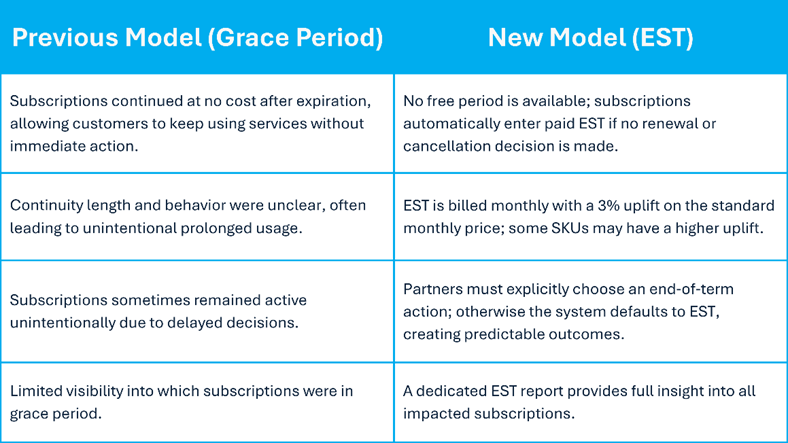
For many years, CSP subscriptions that reached the end of their committed term continued to function even if no renewal, cancellation, or term change had been initiated. This free grace period ensured that customers didn’t immediately lose access, and partners gained additional time to finalize renewal decisions. While this seemed convenient, it created several operational challenges: subscriptions sometimes kept running unintentionally, partners lacked precise visibility into the duration of the free continuity, and customers occasionally consumed services without being billed for them. These issues often resulted in confusion, surprise usage, and inconsistent planning.
What happens from 2026 onward – Introducing Extended Service Terms (EST)
Starting in 2026, this free buffer is discontinued and replaced by Extended Service Terms, a paid, monthly‑billed, and highly flexible post‑expiration period. An eligible subscription automatically enters EST if it reaches its end date, automatic renewal is turned off, and no explicit action has been taken to either renew or cancel it.
During EST, the service continues uninterrupted, but billing immediately switches to the standard monthly price plus a 3% uplift, and certain SKUs may incur an even higher uplift if they do not have an equivalent monthly term. Despite the added cost, EST provides a safety net that prevents customer downtime. It also allows partners to terminate or convert the subscription at any time, and billing is prorated to ensure customers pay only for the exact number of days used during EST. This brings far greater transparency than the previous grace period ever offered.
Key dates every partner must be aware of
Microsoft is rolling out EST in multiple stages to give partners enough time to prepare and make adjustments.
- Beginning on February 16, 2026, new EST‑related renewal, cancellation, and transition options became available directly in Partner Center
- Shortly after, on February 27, 2026, Microsoft released the dedicated EST download report, which partners can use to identify every subscription that is already in or soon will be eligible for EST.
- By March 13, 2026, EST was extended to specialized offers as well.
- The true enforcement milestone arrives on May 4, 2026, when any eligible subscription that has not been explicitly renewed or canceled will automatically transition into EST.
Old system vs. new system – Side‑by‑side comparison
What this means for partners in practice
This update fundamentally shifts the responsibility and mindset around subscription management. Instead of relying on a loosely defined grace period, partners will now need a proactive lifecycle process that ensures all upcoming expirations are reviewed in advance. Since any inaction translates directly into a chargeable EST period, reviewing 60–90‑day upcoming expirations becomes a critical operational necessity.
At the same time, EST acts as a controlled buffer for scenarios where customers legitimately require more time—for example, when approvals or procurement cycles are delayed. The system keeps services active without interruption, but it also encourages timely decision‑making by tying continuation to monthly charges. This leads to a more predictable billing environment for both partners and customers, while reducing unintentional service use.
What this looks like in real scenarios
Consider a situation where a partner simply loses track of a renewal date. Under the previous model, nothing severe would have happened immediately; the subscription would have quietly slipped into a free continuation period. Under the new rules, however, that same inaction causes the subscription to transition into EST, which triggers the uplifted monthly price. This can quickly become an unexpected cost if not monitored closely.
Another realistic scenario involves customers who genuinely need additional decision‑making time. Rather than rushing the renewal or risking service interruption, the partner may deliberately move the subscription into EST. This gives the customer full continuity while allowing them the time they need. Meanwhile, prorated billing ensures they only pay for the number of days used before the final renewal decision is made, which creates a fair and transparent financial arrangement for everyone involved.
Conclusion
The transition from the traditional grace period to the modern EST model introduces clarity, predictability, and structure into the CSP subscription lifecycle. It eliminates accidental free usage, pushes partners toward intentional end‑of‑term decisions, and offers a flexible but billable bridge when more time is required. Partners who adopt a more disciplined renewals workflow, take advantage of the new EST reporting tools, and communicate proactively with customers will benefit the most from this transition.
Need help navigating EST changes? We’re here for you.
If you want support reviewing your upcoming expirations or need assistance planning your EST processes, reach out to us anytime — we’ll help you ensure no subscription ends up in paid EST unintentionally.
👉 Our page: https://partnerbooster.hu/en/
👉 Contact us: https://forms.office.com/Pages/ResponsePage.aspx?id=Zy8WJHqz_kKYUKlshOkzmfF1H_3qR5VIqItVN2VpDdBUNzhUUFJSS0c5MkRaMkZYOTc4UDQ1QkQ2Ni4u